Showing posts with label Augustine. Show all posts

Monday, December 2, 2013

Freedom and Authority

An Introduction and a Summary of the Well-Known Book, Freedom and Authority, Authored by Metropolitan Paulos Mar Gregorios
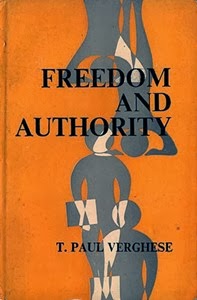
Fr. Paul Verghese (The earlier name of Paulos Mar Gregorios) was invited by the Lutheran seminaries in the United States to give the Hein Lectures in 1968. The lectures were put together to publish the book, The Freedom of Man, in the United States. Later the material of this book was modified and expanded for the situation in India, and was published as Freedom and Authority in 1974 by CLS and ISPCK . In the foreword, he admits that he was inspired for this book by the students, the Blacks, and the women, who are leading the movement for human liberation. He admits his debt to St. Gregory of Nyssa, from whom he learned the meaning of freedom. He is grateful to Nicholas Berdyaev and Vladimir Lossky for leading him to Gregory of Nyssa. He admits that he learned the art of thinking primarily from his western teachers, but the content of his thought primarily came from his own eastern tradition.

In the preface to the Indian edition, he rightly points out that Indians today lack the ability of systematic thinking. We read a lot, and we quote freely, but we rarely do our own original thinking either in sciences or in theology. But he also admits that it might be a good thing that we don't go to the other extreme of spinning out a new theology that goes out of fashion soon. We need some concrete person or institution that materializes the thinking before we can make a judgment. He points out the example of the Marxist parties in India. People are not attracted to Marxism as a way of scientific thinking. Only when the party materializes the Marxist ideas into proximate and manageable goals, the people get attracted. Similarly, the Christian church in India needs to become a community that materializes the Christian faith into proximate and manageable goals. This book, he claims, makes an attempt to present the Christian faith as a coherent set of ideas, and also makes an invitation to try a community life based on it.

In the introduction, he states a major human existential problem as it was clearly visible in the second half of the twentieth century-- the crumpling down of the authority structures. The human community has been held together by authority structures, but today they are falling apart, which threatens the very existence of humanity. Children don't obey parents, wives don't submit to their husbands, and employees don't submit to their employers. Students disobey their teachers, laymen do not obey their priests, and even soldiers defy the commands of their officers. Command has become the least effective way to make others do one's will. Church dogmas were blindly believed, but not any more.
Our world has witnessed in the modern era several movements of freedom:
  1. Political decolonization. 1500 million people all over the world broke their political chains and marched ahead with a new confidence.
  2. Movement against white superiority. The awakening of negro self-consciousness in the Afro-American people.
  3. Revolt against socialist Dictatorships. Countries are gaining freedom from socialist dictatorships.
  4. Revolt against ecclesiastical authority. Catholic bishops and theologians are openly encouraging disobedience to papal authority.
  5. Revolt of Youth against the authority of the older generation.
  6. Revolt of Women against male authority
The Diagnosis
How do we diagnose this situation? Mar Gregorios asserts that there is no need for alarm. Humankind is going through severe pain, but this is not due to any illness. This is merely the birth pangs that would give birth to a new humanity. He further claims that the central element of human evolution is a dialectic between authority and freedom. Humanity grows by discarding freedom-hampering authority structures, and by developing freedom-fostering authority structures. This understanding presupposes three assertions:
  1. Man is basically good by nature.
  2. Real good happens only in freedom, for forced good is not good.
  3. The combination of freedom and good, which may be called love, develops only in the structures of a freedom-fostering human community. 
Authority and freedom look as if they are opposed to each other-- when someone exercises authority, someone else might lose freedom. But it is not so simple as that. We have to ask which authority and which freedom.

Authority can be coercive (arbitrary) or persuasive. Coercive authority disregards the freedom of others, but persuasive authority regards the freedom of others. The authority of parents over children, teachers over students, pastors over parish people, and a government over the citizens needs to be persuasive, not coercive. Whenever some pressure is applied on human will, it reacts to that pressure. Human will always revolts against coercive authority. What kind of authority is God's? Is it coercive or persuasive? In the Old Testament we see a God who is more coercive than persuasive. But the God and father of Jesus Christ is more persuasive than coercive, whose example Jesus Christ asked us to follow.

Freedom is the power to think, feel, speak, and act following one's own will. If someone prevents me from following my own will, I don't have freedom. If I make someone follow my will, he/she is a slave to me. A master exercises coercive authority upon his slave. A slave is not allowed to follow his own will. If he does, it is considered a crime in the system of slavery. In an ideal healthy community, every human individual has freedom. However, one's freedom is limited to his/her own life. One has no freedom to interfere in the life of another person. The freedom to live is a privilege of every human individual. Along with that every human individual has the responsibility to let others have the same freedom. There is no privilege without responsibility.

When we have the freedom to live, and when we let others have their freedom to live, we create rules and willingly submit ourselves to them. Road rules are excellent examples. Where there are road rules and where people strictly follow them, people have the freedom to travel around with very few casualties. A society cannot function without rules. In an authoritarian society, someone creates and enforces rules on the rest of the people. In a democratic society, all people participate in the creation of rules, and all people willingly submit to the rules. Let us imagine heaven, the ideal world. Are there rules there? Yes, there are rules, for without rules no society can function. However, all people willingly and habitually create and follow the rules, and it makes life smooth and joyful for everybody. In contrast, hell may be imagined as a place where no one follows any rules. In heaven, the ideal world, all people are mature, free, and responsible, but in hell all people are immature, bound, and irresponsible.

Our real world is a mixture of both kinds of people. There are mature and immature people, responsible and irresponsible people, those who choose good, and those who choose evil. The presence of good and evil in our world presents an excellent opportunity for people to grow in freedom, maturity, and responsibility. People lack such an opportunity in heaven and in hell, and so there is no opportunity to grow in either of those places.

God is free, and out of his freedom flows only good; no evil. God has granted freedom to humankind-- the right to choose good or evil. Until humankind attains the maturity and perfection of God, humankind will continue to make wrong choices. There might be free beings elsewhere in the universe and also in other dimensions. Our religious traditions call them angels and demons. They also have the freedom to make choices. Thus though good originates from God, evil originates from the wrong choices of the free beings in the world.

So what is our present situation? We are naturally good, and created free. However, we need to grow to maturity-- as perfect as the heavenly father is perfect. We are always surrounded by evil tempting us to choose evil just as Adam and Eve were tempted to make the wrong choice. Jesus himself was not immune from such temptations. He was tempted by Satan to make wrong choices. Nobody is free from such temptations. We have to consciously overcome the temptations and make the right choices as our Lord did. If we do not fall to the temptations of evil, then we will be attacked by the evil forces in various ways. Temptations are internal, but such attacks are mostly external. We need to stand with God and face the powers of evil in our everyday life. Life is a battle with evil.

Augustine, a fourth century father of Latin Christianity, asserted that mankind is basically evil, and so we are not capable of making any right choice at all. Pelagius, a contemporary of Augustine, revolted against this view by going to the other extreme. He claimed that mankind is in a position to easily choose between good and evil. He did not see the power of evil that surrounds us. Along with a low view of Man, Augustine also promoted a low view of this world as well by holding an other-worldly view. The western Christian world, which includes catholic church and protestant churches, still suffers from these distorted views of Augustine. Backed up by political power, the western Christianity spread its influence throughout the world in the past few centuries, and even the eastern Christian churches were not free from their influence.

Attempts to Regain the Original Christianity
So what exists as Christian church in the world today is mostly a distorted version of the original Christianity. As stated by Mar Gregorios, "Official Christianity sounds ludicrously unintelligent and seems utterly unappealing to the moral conscience of mankind, even to many who have not yet given up their Christian faith." There have been several attempts in the modern world to bring Christianity back to its original form. Although none of them has had the power to achieve the goal, they are treated sympathetically by Mar Gregorios. Five of those attempts are listed in the first chapter:
  1. Secularization and Pragmatism. Begun as a revolt against ecclesiastical control, secularization has developed as a religion with its own worldview, according to which the world that appears to our eyes is all that exists, and man is in control of this world with no one above him. Secularization and Pragmatism, its twin sibling born in America, support and reinforce each other. According to pragmatism, usefulness to us determines the meaning and value of everything.
  2. Ontological disillusionment and Existential stance. When secular and pragmatic philosophers refused to deal with the ultimate questions of existence, and set a limit to their quest-- to what we observe or what is useful and relevant to us, philosophers like Husserl and Heidegger stayed in ontological quest asking basic questions of existence. Husserl's quest was for intellectual certainty through careful mapping of the whole region of consciousness. Heidegger seeks the nature of 'being'. Truth for him is an unconcealed relationship between the knower and the known; not a correlation between fact and proposition. Truth is also the knowledge of things in their totality of relationships, the knower included in the whole. Some other philosophers who are under the umbrella of existentialists, such as Kierkegaard, are anti-intellectual and anti-system.
  3. God's death and hermeneutical quest. The Death of God movement in theology was to reform Christianity. In Nietzsche's words, "God as the declaration of war against life, against nature, against the will to live! God-the formula for every lie about the 'beyond'!" It is this God Nietzsche's madman pronounced dead.
    The mainstream theology proceeds within narrow and manageable confines. Instead of considering questions on being, it explores questions like who was historical Jesus, and what is the canon within the canon for interpreting the Bible. This hermeneutical quest is no likely to yield answers to the fundamental questions about human existence.
  4. The Future of Belief and Belief in Future. The Future of Belief is a book by Leslie Dewart which made a minor storm in Catholic circles. He de-supernaturalized God by liberating God from the Greek conception of God. Mar Gregorios suggests that his criticism of classical western theism would have been enriched by a knowledge of the Greek fathers' views.
    A spatially transcendent God , which is quite difficult for western thought, is replaced by a temporal transcendent God. This idea originally came from The Principle of Hope, a book by Ernst Bloch, a German Marxist philosopher. Jewish messianism is the influence behind his thought. The German Theologians like Moltmann, Pannenberg, and Metz, and the American Theologian Harvey Cox are Blochists. Unlike Bloch's view, the Christian hope is based on the Cross and Resurrection, which makes these theologians re-establish the belief in resurrection as a historical event.   
  5. Liberal Humanist and the New Marxist . Humanism believes that the full development of man is possible and is to be striven for. Economic development is regarded by most as the first stage of development. But ideas differ as to the next stages. Liberal Humanist is committed to the unity of mankind and faith in the future of man. The future of man is conceived in simple terms-- cultured, secure, with a pluralistic and permissive social structure. Marxist humanist comes in as a critic of liberal humanist and as a pioneer pointing out that the Liberal humanist's ideas only help to give the glow of morality to a corrupt and dehumanizing system. European Marxists emphasize that man was the cental concern of Marx and so anything that dehumanizes, whether in Communist countries or in the west, is an enemy of Man. Later Marx went to the extreme of denying the authoritarian God to affirm Man. 
The Features of Authentic Christianity
The primary distortion in Christianity, separation of knowledge from life, started as early as second century with Irenaeus. In taking a stand against Gnostics such as Basilides, Cerinthus, and Marcion, who claimed the authority of a secret tradition from the apostles, Irenaeus produced a different set of propositions as inherited from the apostles. Thus the seed sown by Irenaeus further grew up with Origen, who said, "the teaching of the church handed down in unbroken succession from the Apostles, is still preserved and continues to exist in the churches up to the present day, we maintain that that only is to be believed as the truth". The Christian faith has been reduced to a set of doctrines. Origen further claimed that a few doctrines were left behind unclarified by the apostles for the later theologians to work on.

The Cappadocian fathers, however, asserted that the knowledge of God is depended on ethical maturity. There is no way of knowing God apart from living a Godly life. Holiness is not a matter of ethical purity; it involves transfiguration of the very being of man into the likeness and image of God. Among the Cappadocian fathers, it was Gregory of Nyssa who presented this thought most systematically.

For the Stoics, who saw God as the soul of the world, God could not be independent of the world. But God is fully transcendent and free of the world for Gregory. Manicheeism held that matter existed eternally alongside God, and was the source of evil. But for Gregory, the material world exists within God, for matter itself is spiritual (a form of energy as we would say). Being the image of God, Man has to be free like God. Evil has its source in this freedom. Gregory also held that evil, as the absence of good, has no ultimate reality. It is in the struggle against evil that man develops his freedom and becomes mature.

Gregory's thought may be compared to Indian thought especially with Sankara's Advita Vendanta and Ramanuja's Vishishtadvaita. Ramanuja's thought is similar to the Stoics in viewing the Cosmos as the body of God. For Sankara, the Cosmos is Brahman misunderstood by avidya. For Gregory, seeing from the perspective of the cosmos, it exists apart from God, and it comes into being from the will of God. However, seeing from God's perspective, nothing exists apart from God, who is infinite.

Gregory views the difference between the creator and creation as follows: creator's being is self-dependent, but creation's being is dependent on God. Also creator's being is no need of a becoming, but the creation's being is in a state of becoming. For Gregory, man's existence in time is not a mere illusion or a dream, but of eternal significance. But for Sankara, the historical existence makes no difference to the jivatma.

The Way Forward
What lies ahead in our way toward genuine freedom? We have to really make the trip in order to find out. Only a few guidelines about how we may make the trip is possible.

The king needs to be replaced with shepherd. The king uses coercive authority, but the shepherd uses persuasive authority. God needs to be seen as a shepherd rather than a king. All the shepherds in the world in all walks of life, including governments, receive their authority from God, the real shepherd, and they need to learn to use persuasive authority. They need to become good shepherds as Jesus describes in John 10 by caring for the sheep and by developing a warm and a healthy relationship with them.

Attempts to grasp the ultimate reality need to be abandoned. Any attempt to conceptualize it leads us to frustration. We need to maintain right relationship with the ultimate reality. Being far beyond our power of comprehension, the ultimate reality needs to be praised and adored.

A positive and appropriate attitude needs to be developed about our tradition, the path we have already covered. We need to acknowledge our past, with its successes and failures, in order to make a victorious journey forward. We need to become aware of the common heritage of the humanity as a whole. Openness to future without sufficient awareness of the past is superficial. Loyalty to the past tradition without openness to the present or future prevents us from moving on.

Discipline needs to be developed with the awareness that if you need to get freedom, you have to give freedom to others. No privilege without responsibility. People should willingly take part in creating laws and also should willingly obey those laws. 

These principles need to be experimented in the laboratories of communities, so that once they are proved to be successful, they can be followed by the human community as a whole. An experimental community needs to be ecumenical with people of various races, of various religious traditions, and of both sexes. Tagore's Shantiniketan, Gandhi's Sabarmati Ashram, and Aurobindo's Ashram are examples of community experiments in India.

Thursday, July 21, 2011

St. Augustine's Role in the History of Christianity

It wouldn't be incorrect to affirm that Augustine is the primary architect of the western Christianity. Even Jesus and Paul were seen by the western Christianity through Augustine's eyes. An examination of Augustine's view of life and its origin will provide the key to many of the perplexing questions regarding the divisions and deviations occurred in the historical development of Christianity. Although Augustine was accepted as the primary father and doctor in the Western church, he was not accepted as a father or a doctor in the Eastern Church. His views were mostly unacceptable to the east.
          Augustine developed a view of God different from that of the east, according to which, the Holy Spirit proceeds from both Father and the Son. Later the Nicene Creed was altered by the western Church to include this modification. Moreover, the Holy Spirit was seen as the love that links Father and Son. Such an approach to Trinity was offensive to the East, which had developed its understanding of the Triune God over several centuries. The east had realized that God is incomprehensible, and that God can be known only through His activities. The Trinity made sense only in the presence of the world. However, Augustine's was an objective view of God – an analysis of the ousia (essence) of God without any reference to the world.
         Augustine also promoted a low view of humanity, according to which human beings are basically evil, and they are incapable of anything good. The world for Augustine was an evil place, and salvation was escaping from the world and going to the heaven above.  Adam's sin was inherited by all humanity, which made all people born with original sin. The Eastern fathers claimed that humanity inherited only the consequences of Adam's sin, and not sin itself.
   Greek was the primary language of Christianity as it developed beyond Palestine, and its leaders were Greek-speaking. Christianity was slowly entering the Latin world during the time of Augustine, and Latin was his native language. From his own account, he was a precocious and able student, much enamored of the Latin classics, Virgil in particular. Augustine didn't know Greek, and he couldn't engage in a communication with the Greek fathers.  Thus the views and concepts he developed were so different and in some cases even contradictory to the established views in the east. If he had known Greek, the history of Christianity could have been different.
   At the age of 19 he developed a passion for philosophy, which was a pursuit of wisdom that included what are now viewed as the separate spheres of philosophy, religion, and psychology. He had a concern with the issue of how to make sense of and live within a world that seemed so adversarial and filled with danger, a world in which so much of what matters most to us is so easily lost [e.g. Confessions IV.x.15]. The one system of thought which was accessible to him and which satisfied his quest was Manichaeism. He remained within this system of thought for nine years. The Manicheans proposed a powerful explanation of the problem of evil: there is a perpetual struggle between co-eternal principles of Light and Darkness (good and evil), and our souls are particles of Light which have become trapped in the Darkness of the physical world. By means of sufficient insight and a sufficiently ascetic life, however, one could eventually, over the course of several lives, come to liberate the Light within from the surrounding Darkness, thus rejoining the larger Light of which the soul is but a fragmented and isolated part.
   Later when Augustine was influenced by other thought systems such as Neo-Platonism and Christianity, he repudiated Manichaeism. In his writings against Manichaeism, he focused upon their implicit materialism, their substantive dualism whereby Darkness, and hence, evil, is granted a co-eternal, substantial existence opposed to the Light, and their identification of the human soul as a fragmented particle of the Light. Although Augustine is vehement in his repudiation of the Manicheans, one can see the influence of the Manichean world-view in Augustine’s thought.

Wednesday, June 22, 2011

What is Wrong with Secularism?

Secularism is one of the major topics dealt with by Metropolitan Paulos Mar Gregorios. He was never tired of explaining how harmful secularism is in a number of his books and in numerous research papers. Here I am making an attempt to introduce in a few words what Mar Gregorios was trying to tell us through these books and papers.

Enlightenment East and West, A Light Too Bright, and The Secular Ideology are the three major works that deal with this topic. About the first two books, he says in his autobiography:
More recently I have done some significant non-theological writing. The Indian Institute of Advanced Study gave me a study fellowship which enabled me to write my Enlightenment: East and West, published by that Institute and favorably reviewed in India. The State University of New York Press wanted to publish it jointly with the Institute, but the latter was not willing for some reason. In any case, the Shimla book had been written with an Indian readership in mind, pointing out that the great Founding Father of our nation, Jawaharlal Nehru, was primarily a child of the European Enlightenment, and not a promoter of the Indian heritage. For SUNY Press, I decided to write another book on the same theme, this time with the western readership in mind. That came out in 1992 under the title A Light Too Bright: The Enlightenment Today. Reviews so far have been favorable, though not raving.
The Secular Ideology is a collection of essays which were put together by Mar Gregorios toward the eve of his life. However, it could be published only in 1998, two years after his passing. This book deals with secularism in the specific context of India.
Also he dealt with this theme in the Dudley Lectures at Harvard. He says:
I gave the Dudley Lecture at Harvard University in 1979, questioning the then prevailing thesis that secularization was an irreversible process. I saw then that religion had to come back into public life in some new form, and would do so fairly soon. That was an unfashionable view for the establishment, and Harvard Theological Review, which had agreed in advance to publish my lecture, regretted their inability to abide by the agreement.
Although his lecture was not published as such, a report of his lecture appeared in the Divinity Bulletin of the Harvard Divinity School.4 

What is Secular?
Mar Gregorios traces the meaning of this word from the beginning of the Christian era. The Latin word Saeculum meant world. When a lot of people renounced the world (saeculum) and adopted a life of monastic rule (regula), a distinction developed as religious (monastic) and secular (non-monastic). During the French revolution, a property under the control of a monastery was taken away from its control and brought under public ownership. This process was called secularization.
A few centuries ago Christianity was the state religion in Europe. In those days an organized church controlled the state as well as all the political, economic, academic and cultural institutions of society. It took a very long process, both revolutionary and evolutionary, to liberate the state and the institutions of society from the control of the church. This process was called secularization.
What do we mean today when we say that India is a secular state? It means India is not like its neighboring state, Pakistan, which has adapted a particular religion as its state religion. Non-Muslims are second class citizens in Pakistan. For example, a non-Muslim cannot witness against a Muslim.  In India, all people are given equal rights regardless of their religious affiliation, resisting the very strong pressure from the majority religious community belonging to Hinduism to make it the state religion. 
What is Secularism?
Although the word secularism sounds related to secular, it has a very different meaning. Mar Gregorios asserts that secularism belongs to the category of religions. It is an ideological system of concepts and values. Here is a definition of secularism from a 19th century American orator.
“Secularism is a religion, a religion that is understood. It has no mysteries, no mumblings, no priests, no ceremonies, no falsehoods, no miracles, and no persecutions. Secularism is the religion of humanity; it embraces the affairs of this world; it is interested in everything that touches the welfare of a sentient being; it advocates attention to the particular planet in which we happen to live; it means that each individual counts for something; it is a declaration of intellectual independence; it means that the pew is superior to the pulpit, that those who bear the burdens shall have the profits and that they who fill the purse shall hold the strings.” Robert Green Ingersoll, (1833-1899) 5 
Secularism seems to be a full-fledged ideological system developed in revolt against the domination of Christian church in Europe. It is very important to distinguish between secular and secularism because they are not the same. India is a secular state, but not a state of secularism. If India adopts secularism as its state religion, it will be another nation like Pakistan, and it won’t be secular any more.  
It seems that the religion of secularism is slowly bringing the entire world under its control.
In Saving Leonardo, Nancy Pearcey makes a compelling case that secularism is destructive and dehumanizing.   Pearcey reveals the goal of the book at the outset: "to equip you to detect, decipher, and defeat the monolithic secularism that is spreading rapidly and imposing its values on your family and hometown."6   Like Europe was controlled by the church in the Middle Ages, this new religion has already taken control of the whole world. It looks like the world is in need of another secularization to get out of the control of secularism.
Secularism is fine as long as it stays as one of the religions, but we don’t want it to become the state religion or ideology. What we want is a secular state like the one we have in India, not a state controlled by secularism.
The Context in India
The unity of the nation is in danger due to communal conflicts. The solution being suggested by so many intellectuals is the adoption of secularism. They seem to make such a suggestion primarily because they do not distinguish between secular and secularism. Mar Gregorios suggests that secularism is a religion, and it can coexist with other religions in India, but it should not become the state religion. Jawaharlal Nehru and Sarveppalli Radhakrishman represent two different approaches to secularism.
Nehru, as the first prime minister of the free India, had a very difficult task, and he suggested a secular and scientific approach for India’s development. In Discovery of India he wrote:
“The modern mind ….. is practical and pragmatic, ethical and social, altruistic and humanitarian. … It has discarded the philosophical approach of the ancients; their search for ultimate reality, as well as the devotionalism and mysticism of the medieval period. Humanity is its God, and social science it religion.”7
This is the view followed by a lot of intellectuals in India today. Although Nehru had a vision of India, the truth is that he did not lay down any proper intellectual foundations for his secular scientific approach. If we are faithful to his vision, we have to honestly question some of his assumptions. We will be dishonoring his vision if we take his assumptions as dogmatic truth.
We don’t need to go very far for a correction to Nehru’s view. S. Radhakrishnan, the Rashtrapathi of India and a close friend to Nehru, had a very different view from Nehru. Although western-educated like Nehru, his vision was not grounded on the western secularism or a scientific view; his was firmly grounded on the traditional Upanishadic view of life. He believed in the unity of all that exists. He recognized as early as 1940s that a purely secular materialist Marxist movement, however revolutionary and creative it may at first appear to be, could not but come to grief.
How do we face the threat of Secularism?
The best way to deal with secularism might be to find the roots of secularism and try to eliminate them. The primary root of secularism seems to lie in the false dichotomous worldview that divides the world into natural and supernatural. Such a worldview existed in the western Latin branch of Christianity since fourth century.  Nature according to this false view is what we can experience and understand without revelation. It is a self-contained realm operating by its own principles different from the realm of revelation, grace, and super-nature. God can occasionally intervene in the realm of nature causing supernatural events of grace, revelation and miracles.
Nature, according to this view, is far away from the supernatural and from God, which makes it evil. Salvation is for man to escape from this realm and enter the supernatural realm. Christ came down from the supernatural realm to the natural realm to save the human beings who were to be saved. Church is the group of the saved people eagerly waiting to get out of this miserable place and get transported to the realm above. Church members are definitely superior to the nonmembers. This view made the Christians look down upon others and rule over them.
People started revolting against this dichotomous worldview by denying the existence of a supernatural realm. If there is no supernatural, all that is left is our natural realm that we see around us.  There is nothing beyond what we can perceive with our five senses, and whatever exists can be studied by our science. This is the creed of secularism, and it empowered the philosophical movement called European Enlightenment.
Secularism has been successful in helping people break free from the dichotomic worldview. However, it has not been successful in providing a functional meaningful alternative. It saved us heroically from the false dichotomic view, but it failed in providing us a view on which we can build up our life. It fails to answer so many of our basic questions about our life. Our questions such as what we are, why we live, and how we are related to each other have no answers from secularism.
If secularism cannot be an alternative to the dichotomic worldview, what else can be the alternative? The dichotomic worldview is the product of the western Latin branch of the Christian church with its primary theologian, St. Augustine of fourth century. The eastern Greek branch of the Christian church did not share this worldview. The Cappadocian fathers such as St. Basil, Gregory of Nyssa, and Gregory of Nazianzus were the primary Greek theologians in fourth century.
The thought of Gregory of Nyssa has been studied in depth by the scholarly world in our time, and the results have been exciting. Gregory calls all that exists Ta Panta in Greek. Gregory does not divide Ta Panta into natural and supernatural. But he divides Ta Panta into created and uncreated. The uncreated existence is infinite (beyond the limits of time-space) but the created existence is finite. Such a division exists when viewed from the perspective of the created existence; but viewed from the side of the uncreated existence, even such a division disappears. If the uncreated existence (God) is infinite, the created existence (world), which is finite, cannot stay apart from it. This idea goes along with what St. Paul said to his audience in Athens, “In Him we live and move and have our being”.
Traditionally all that exists was denoted by the expression “heaven and earth”. In the beginning God created the heaven and the earth. Gen. 1:1. The Nicene Creed also uses the same expression. “I believe in one God, the Father Almighty, Maker of heaven and earth, and of all things visible and invisible.” Made during the time of Gregory of Nyssa, this statement reveals an important division within the created world—visible and invisible. It is true that the Eastern Greek Christianity made such a distinction of visible and invisible, but it is not the same as the division into natural and supernatural.  
Salvation for the eastern Greek Church was theosis, which is for the whole creation growing to the likeness of God; not some people escaping from this world and going to the supernatural world. Church was seen as the visible body of the invisible Christ, and its role was to serve and not to be served. The church members did not see themselves superior to nonmembers. The church assembled on Sundays to intercede on behalf the whole world because the church saw itself as a part of the humanity.  
Paulos Mar Gregorios did an excellent study of the thought of Gregory of Nyssa in his doctoral dissertation, which was later published as Cosmic Man.8 He says about this book in his auto biography:
My doctoral dissertation submitted to Serampore University was published in 1980 by Sophia Publications, New Delhi, under the title Cosmic Man. It dealt with the relation between God, Humanity and World in the 4th century Eastern Christian Father St. Gregory of Nyssa. It was later republished under the same title in 1988 by Paragon, New York. It is a work that I had expected to be well received, but that has not been the case. I hope it will be studied more seriously by people in the future, for it deals with one of the fundamental problems of Christian Theism. People who believe in God often simply take it for granted that God, Humanity and World are three entities, while Gregory of Nyssa had already seen the philosophical problem of seeing the Creator and the Creation as two entities distinct from each other. The Hindu Advaita Vedantin’s point was recognized as basically sound and legitimate, though formulated and explained differently, by this ancient Asian writer from Cappadocia in Asia Minor (present-day Turkey). Gregory of Nyssa lived and wrote three or four centuries before Sankara in India.
Conclusion
Secularism is a new religion which is only about four centuries old. It did a great service to humanity by saving it from the domination of western Christian church. It made sense to a lot of educated people throughout the world, who have renounced their original religions and embraced this new religion. As long as it stays as one of the religions, it is not a threat to humanity. We don’t want to question the freedom of people to get converted from one religion to another one. But it becomes a great threat if it takes control of the governments and institutions of education as the western Christian church did in the medieval Europe. It does this under the guise of something other than a religion.
This reminds me of the old story of a fox becoming a king of animals. Once a fox fell in a bucket of white paint, and he looked very different. All the animals accepted him as their king and began to respect him and obey his orders. One day the fox instinctively howled when he heard a fox howling at a distance, and immediately the other animals realized his real identity and jumped on him. Today secularism is able to gain control of governments and institutions of educations because it doesn’t appear a religion outwardly. The truth is that it is a religion, and nothing more than a religion. Once people all over the world realize the true identity of secularism, it can’t retain its power. What we need is a secular world; not a world dominated by secularism.
References
  1. Gregorios, Paulos. (1989). Enlightenment East and West: Pointers in the Quest for India's Secular Identity. Shimla: Indian Institute of Advanced Study/NewDelhi: B. R. Publishing Corporation.
  2. Gregorios, Paulos. (1992). A Light Too Bright. Albany, New York: State University of NewYork Press.
  3. Gregorios, Paulos. (1998). The Secular Ideology: An Impotent Remedy for India's Communal Problem. Kottaym: MGF/NewDelhi: ISPCK.
  4. http://paulosmargregorios.info/English%20Articles/Dudlean_lectures.html
  5. http://www.infidels.org/library/historical/robert_ingersoll/secularism.html
  6. http://www.bhpublishinggroup.com/savingleonardo/about-saving-leonardo.html.
  7. Nehru, J. (1946). Discovery of India, Calcutta: Signet Press. P.680
  8. Gregorios, Paulos. (1982). Cosmic Man. The Divine Presence: NewDelhi/Kottayam: Sophia Publications
For Further Reading
  1.  Sacred roots of secularism
  2. Who are we in Bharatvarsha today?
  3. Communal Conflicts in India
  4. Nature, man, and God
  5. Dudley Lecture
  6. Communal Harmony